
Abstract
Independent India’s defence trajectory (submarines, T72 tanks, MiG) underwent a drastic geopolitical transition in the 1960s and early 1970s, thereby striking a switch from its longstanding dependence on British naval platforms to venturing into a strategic partnership with the then USSR – the Soviet Union (now Russia). New Delhi therefore decided to seek refuge from then technologically advanced USSR to curb the emerging border threats – particularly from Pakistan. The materialisation of their newly developing relationship was finalised through the acquisition of Soviet naval platforms –notably the Osa-I class missile boats which changed the course of Indian Navy’s history in the 1971 India Pakistan War.
The landmark event in this realignment of relations between partner nations was the Indo-Soviet Treaty of Peace, Friendship, and Cooperation signed in August 1971. Inked at a crucial juncture in geopolitics, when war with Pakistan seemed inevitable, this friendship treaty provided India the assurance she needed against potential external intervention. This not only developed diplomatic relations between the two countries but also marked the foundation for reshaping India’s defence partnership.
The Russian support and offensive use of the missile boats in the 1971 India Pakistan War proved the world the success of the treaty. Despite fluctuations in the post–Cold War era, it continues to serve as the backbone of bilateral ties—particularly in naval defence—where sustained cooperation, technology transfer, reflect the depth and resilience of the partnership.
Key Words: India, Indian Navy, 1971 India-Pakistan War, Soviet Union,
“We cannot afford to be weak at sea, and history has shown that whatever power controls the Indian Ocean has, in the first instance, India’s seaborne trade at her mercy, and in the second, India’s very independence itself.” - Prime Minister Pandit Jawaharlal Nehru1.
Introduction:
India, with its vast coastline and strategic location in the Indian Ocean (IO), has always been conscious of the need for a strong navy. Since its Independence, India has always been crippled by various issues attempting to cause harm to her territorial integrity. This has therefore resulted in her necessitating the need for strategic recalibrations to make her presence felt in the global politics. India’s political leadership since Independence have stressed on her maintaining a non-aligned stance to preserve India’s strategic Independence and to steer away from any power nexus prevalent in international politics. Despite this after gaining Independence, the colonial mindset did not leave the Indian soil. Dependency on British military hardware, institutional practices were inherited as colonial legacy and were followed diligently. The newly established Royal Indian Navy (RIN) in 1947 post-Independence in her teething years therefore found herself fixated in these age-old British military traditions consequently holding herself back in the race for capacity enhancements. Strengthening her fleet strength with older ships from the British, the Indian Navy (IN) over the years, especially in the decades of 1960’s and 1970’s, witnessed the ups and downs in the geopolitical environment like never before.
Looked upon as the Cinderella of the Armed Forces until the 1971 War, the IN turned the course of India’s Maritime military history after its contribution in this extremely short, yet very effective 14 – days war in December 1971. The lessons and setbacks that the Navy faced in the various wars in the preceding years thereby helped her improvise on defence preparedness and ultimately resulted in her performing way beyond everyone’s expectations in the 1971 war. The IN before the 1971 war witnessed a history shift in her defence trajectory – a tangent shift partnering with the Soviet Union rather than relying on the Western powers – primarily the British to acquire naval platforms and hardware. The 1971 War was therefore a turning point in the history of the IN – especially when the Soviet acquired missile boats outperformed everyone and took the world by a surprise, ultimately altering the Balance of Power (BoP) in the Indian Ocean Region (IOR).
How did this happen?... Factors such as meticulous planning, exemplary execution, out of the box thinking, unconventional leadership, interoperability between the armed forces, capacity and capability enhancements, and many others, albeit with some glitches, broadened the horizons of many strategists, researchers, observers and analysts from the military domain to study this war not only at the national level but also globally. (Kesnur, 2021).
India’s newfound inclination towards at Soviet during the 1960’s was the result of the emergence of China as an important contender in the IOR. Pakistan’s, close ties with China, drew the attention of America. America therefore saw Pakistan as its ally and welcomed Pakistan with open arms in various military organisations like Southeast Asia Treaty Organisation (SEATO) and Central Treaty Organisation (CENTO) (Kundi, 2009). America to secure its interests in the region, sponsored Pakistan with financial and military aid to modernise its capabilities in its fight against India and the resultant being the 1965 Indi-Pakistan War. With Pakistan-China and America triad in the background, the rise of China and the 1962 India China War brought various security challenges. India’s embarrassing defeat (Hindi-Chini Bhai Bhai) brought to the forefront a wide spectrum of deficiencies in India’s military preparedness and stressed for the need for India to strengthen its military capabilities. The defence forces realised their shortcomings: infrastructure, repair facilities, and logistical support, which hindered their operational effectiveness. While at the same time it also underlined India’s flaws for overtly relying on the Western powers for her capacity modernisation. Despite this, India continued to rely heavily on the British defence equipment (naval assets like destroyers, frigates, aircraft carriers) and training as previously mentioned due to structural continuity inherited from the colonial era. It was long before India realised that the promises made by United Kingdom with reference to the modernisation (the IN and her fleet) were never meant to be fulfilled.
At such a period of time, Soviet’s strategic move of stepping forward to provide India with the technical assistance, military equipment proved to be blessing in disguise. Soviet without imposing any restrictive political conditions, gave Indian the assurance it needed. India looked up to Soviet as a viable alternative partner in comparison to the Western powers, whose technology and equipment were relatively cheap yet effective and efficient (Srivastava, 2017). This India-Russia partnership was a win-win not just for India but also Russia, for India procured the technology it longed for and Russia could spread its own influence whilst countering the growing presence of America and China in the region (Srivastava, 2017).
By the late 1960’s the political environment between East and West Pakistan had heated up. Neither was demand for greater autonomy nor was the election result acceptable to the west ultimately resulting in widespread riots, civil unrest and repression in the Eastern province (Kesnur, 2021)2. There was a massive influx of refugees in India and catering for their basic needs: food, clothing shelter became a difficult task. India also tapped the doors of the United Nations (UN) to create conditions for the safe transit of the refugees, but the international community did not pay any heed to it. In this context, India and Soviet Union inked a Treaty of Peace, Friendship and Co-operation in August 1971. Though not being considered as a formal military alliance, the treaty outlined fundamental principles of mutual relations such as respect for each other's sovereignty and interests, good neighbourliness and peaceful co-existence (Press Information Bureau, 2017). For India this treaty provided the diplomatic assurance when the world view towards her was uncertain.
The induction of the missile boats enhanced operational capabilities of the IN before and during the wartime. The procurement led to the crew being trained extensively at Vladivostok, somewhere in the Far-Eastern side of Siberian wastelands of Russia (Jerath, 2013). The benefits of the training were evident when the missile boats struck the targets precisely and inflicted major damage to the adversary. The tactical and strategic advantages gained as a result of the missile boats gave the Navy an upper hand to stress on the importance of technological innovation in shaping the outcome of modern warfare. The Navy after the war turned towards modernisation of the fleet and integrated Soviet technologies more deeply into its operational framework. In doing do, India and her Navy gained recognition as a regional maritime power whilst emphasising the strategic foundations of its alliance with Soviet Union.
Objectives:
The paper aims to examine the reasons for India’s tilt towards the Soviet in the decade of late 1960’s – early 1970’s with special focus on the naval modernisation during the aforementioned decades, the consequences of India’s tilt towards the USSR and the role of the Osa Class missile boats in forming the offensive naval strategy and their evolved partnerships. Through this paper, the readers will get deeper insights into the geopolitics during the decades of 1960’s-70’s and India’s diplomatic efforts and defence budget allocation. It will provide the readers a comprehensive understanding of diplomacy, asset (technology) procurement, and naval strategy through the role played by the Soviet in the evolution of the navy’s security policy.
Literature Review:
The existing literature on the evolution of the IN, the 1971 India–Pakistan War, and India–Russia strategic relations comprise official naval histories, memoirs of senior naval officers, government publications, and scholarly articles. Foundational works such as Under Two Ensigns, Blueprint to Bluewater, and Transition to Triumph trace the organisational and operational development of the Indian Navy, while 25 Missile Boat Squadron, The Man Who Bombed Karachi, and War in the Indian Ocean provide first-hand accounts of the Navy's wartime operations and the significance of Indo-Soviet defence cooperation during the 1971 War. Scholarly articles further examine the operational lessons of the conflict.
While these studies provide valuable insights into the IN’s development and India-Russian relations, they largely examine the two themes independently. Limited literature explores how sustained India–Russia defence cooperation, particularly in naval modernisation, technology transfer, and strategic collaboration, shaped the IN's post-1971 evolution. This study seeks to address this gap by analysing the contribution of India-Russian strategic cooperation to the transformation of the IN into a modern maritime force.
Findings and Discussions:
The genesis of the IN can be traced back to the RIN. The RIN was formed during British rule in India in 1934. The primary objective of the RIN was to protect British shipping interests in the IO and maintain law and order on the Indian coast. During World War II, the RIN played a significant role in escorting convoys, minesweeping, and providing naval gunfire support (Marshall, 2012). However, the Indian sailors in the RIN felt discriminated against and were unhappy with their pay and working conditions. This led to the RIN Mutiny in February 1946, which was a significant event in India's struggle for independence.
“At the stroke of the Midnight Hour…” on 15th August 1947 two independent nations namely India and Pakistan were created and so were the military assets split between the two countries. The then existing RIN split into RIN and the Pakistan Navy. Though the country gained independence from the colonial rule, it still followed the British customs and traditions – the Prefix ‘Royal’ from the ‘RIN’ was dropped on 26 January 1950 after India became a Republic (Singh, 1986).
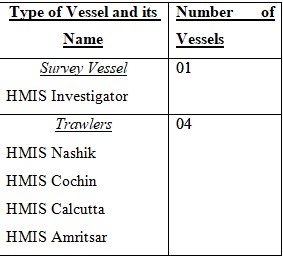
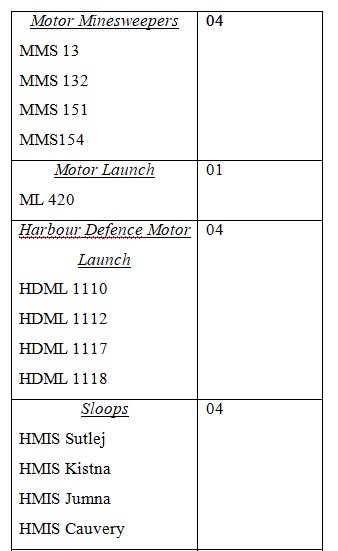
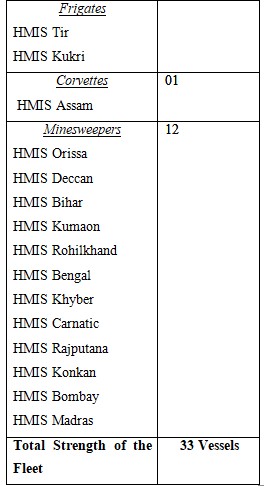
Table 1: Indian Navy’s Fleet strength as on 15 August 1947.
Source: Compiled by the author with reference from Under Two Ensigns: The Indian Navy 1945-1950 by Rear Admiral Satyindra Singh, (Retd.), Oxford & IBH Publishing Co., New Delhi, India.
Immediately after independence in 1947, the Navy despite limited resources saw action in “Exercise Peace”3 – Annexation of Junagadh (Singh, 1986). India was asked to resolve its territorial boarder disputes with the neighbouring countries either bi-laterally or in the British Commonwealth or the UN (Hiranadani, 2005). The defence forces considering the security threats (internal and external) thought it was appropriate to come up with a military policy that would go hand in hand with India’s economic growth and development. Accordingly, the first 10-year plan drafted in 1947 tasked the Navy with safeguarding the Indian shipping, ensuring that supplies could reach and leave by sea in all circumstances, preventing an enemy landing on Indian shores, and supporting the army in seaborne operations (Marshall, 2012). The limited capacities and capabilities coupled with budget restraints curtailed Navy’s freedom primarily to patrolling and defending duties of navigable inland water and coastal water, ports, and harbours (Marshall, 2012). The Navy’s limited ‘Charter of Duties’ resulted in it being recognised as a brown water4 navy which was against the wishes of the visionaries in the policy framework as they envisaged for a greater role for the Navy. The British Admiralty through the talks with the then CNS had realised that the Indian Ministry of Defence (MoD) envisaged the IN to be proactive capable of carrying out major operations of naval warfare. In September 1948, a 69 ship Navy was proposed (Hiranandani, 2000). The Naval Plans Paper 1/47 which specified roadmap for the modernisation and expansion of the IN, proposed that the Navy in the next 10 years would comprise two light fleet carriers, three cruisers, eight destroyers, four submarines and other smaller vessels (Sarangi, 2020). However, the geopolitical environment caused alterations in this Plan of Action (PoA) and consequently the Navy had to settle down for less.
By 1950 the two major contestants of the Cold War, United States of America (USA) and USSR began inviting the newly independent nations (India and Pakistan) to form a part of their alliance. While India determined to stay non-aligned, Pakistan joined USA and became a party to CENTO and SEATO military alliances (Hiranadani, 2005). As party to such affiliations, Pakistan received huge economic aid from USA to counter the spread of Communism. Moreover, the bond between Pakistan and USA was solidifying intensively with signing of multiple defence assistance agreements, transfer of naval assets (Sarangi, 2020). Knowing Pakistan and their ulterior motives very well, it was clear that all of strengthening of naval power would be used well against India. The increased number of naval assets with Pakistan therefore compelled the NHQ to further strengthen its naval repository. Russia even though conceived India was more “Imperialist” because of its reliance on the West proposed to assist India in her Naval development (Hiranandani, 2000). However, IN’s reliance on the British armoury made it difficult for her to choose between the two and didn’t wish to risk shifting to a new supplier (Hiranandani, 2000). Moreover, dealing with the Anti-Russian mindset was a more tough task to deal than convincing the bureaucrats to look at new approaches and shift towards Russia.
India even though a peninsular country, has always had a continental mindset. Most of the threats that India faced since Independence even though primarily not continental, have been perceived from a continental mindset. This is the reason why from her (India’s) Independence in 1947 up to the early 2000’s the Navy has always been allocated less than 15% of the total budget share (Marshall, 2012). This justifies the navy being recognised as a ‘Cinderella Service’ despite being geographically advantaged. Despite Navy’s big action in the liberation of Goa in 1961, priority has always been given to the Indian Army (IA) and Indian Air Force (IAF) to cope with China (Hiranadani, 2005). The wartime statement reiterates the fact that the Navy’s support is for the outcomes on land. Hence the focus and investment to development in the Navy has always been in relation to India’s continental problems.
The 1962 Sino-India War was purely a land operation in which the IN was absent. Britain at this juncture not only withdrew the remnants of her naval forces from the East of Suez but was also reluctant to remain India’s traditional supplier of naval hardware. The leaders of Britain believed IN should primarily rely on coastal defence. The rise of communism and the Russia’s efforts to spread its influence in the IO resulted the Royal Navy (RN) being selective on the transfer of submarines to India. On the other hand, it was still positive towards India procuring of anti-submarine warfare (ASW) frigates (Sarangi, 2020).
The twofold reason given for refusal of transfer of assets: a) RN was being downsized and couldn’t spare any vessels (from Indian demands) to supply to India, b) budget restrictions resulting in Britain’s inability to process India’s immediate naval requirements. Consequently, those which were offered were at higher costs and hence the Indian Government also refused to accept the deal.
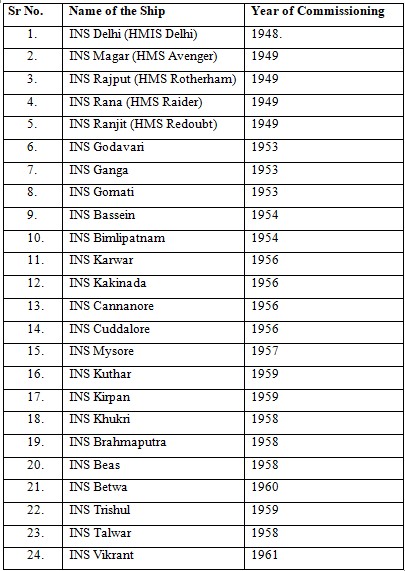
Table 2: Ships supplied by Britain Source: Author
The Indian Naval budget was, for once, increased to 5.94 percent and having observed the British attitude to India’s request for assistance to develop her Navy, India looked up to the then Soviet Union for submarines, gas turbine propulsion, missiles and landing craft. The IN learning its bittersweet lessons for its overreliance on the West decided to be positive and open to the offers from Soviet in 1965 to supply India with the ships and Submarines (Hiranadani, 2005). However, a change to a Russian system meant many unsaid implications: a complete makeover in training, maintenance, logistic, technical, operational and tactical procedures and systems (Hiranandani, 2000).
However, the geopolitical environment became highly volatile and India had to go for a War with Pakistan in 1965. During the 1965 hostilities, Pakistan Navy (PN) vessels masqueraded as merchantmen bombarded Dwarka on September 07, 1965. The IN proposed a retaliatory strike but could not be due to the political orders that restricted their capabilities. As a result, the IN’s Fleet was deployed on the east coast until Pakistan launched a major offensive on 01 September 1965, post which the ships sailed from Visakhapatnam for Bombay.
Though the formal alliance between the two countries was marked post the 1965 War, an important milestone in their relationship was way back in 1950’s when Russia used its veto for the Kashmir issue and stood in solidarity with India. The beginning of Russian import therefore ended the traditional dependence on the RN for naval hardware as well as for guidance and assistance. Though delayed, the Russian ships ordered in 1965, gradually arrived in India by 1968. On one hand, the Russian technology was more advanced as compared to technology in the British supplied vessels while on the other, the Russian vessels were better suited for Russian needs – the temperatures, the sea state, ship capacity etc (Hiranadani, 2005). Efforts were made to modify and customise the Indian Naval order as per the Indian needs and climatic conditions, but as the vessels were already under construction, the Russians convinced the Indian delegations that their vessels would sustain the tropical conditions and any feedback from the Indian would be taken into consideration for the next order as it would help improve the design. To accommodate the growing order and the number of Russian ships, India’s naval base at Vishakhapatnam was modernised with the help of the USSR (Srivastava, 2017).
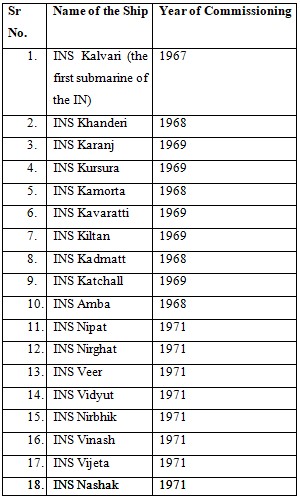
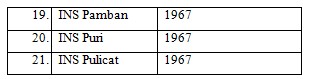
Table 3: Ships supplied by Russia (Source: Author)
After well sought discussions, the deal to acquire the missile boats received a green go-ahead. Primarily suited for coastal defence, the missile boats would prevent any hit and scoot by Pakistan on Bombay as done by them 1965 War. The lethality of the missile boats through the sinking of the Israeli frigate by Egypt in the 6-day Arab Israeli War changed naval warfare: prolonged gun battles between opposing warships (Hiranandani, 2000). Orders were placed and “The Indian Navy had entered the age of the missiles!” (Jerath, 2013). Designated as the 25 Missile Boat Squadron, the crew was deployed to Russia to complete their training formalities. New innovative techniques were thought of to facilitate their transport to India and conserve their machinery; the missile boats were lightened and loaded on heavy lift merchant ships. Modifications to the missile boats which the Russians were unable to accommodate were achieved the Indian dockyards (Ahluwalia, 2016).
By 1971 the geopolitical environment was tense with internal tensions building up within East and West Pakistan. Pakistan’s friendly relations with China were boon to America to help develop links with China. In appreciation of this support, USA adopted a strongly pro-Pakistan and anti-India position during the latter half of 1971. In response to this shift in US policy, India sought to balance the situation by signing the Treaty of Friendship with the Soviet Union in August 1971, an agreement that had been under negotiation since 1969. Russia vetoed in the UN Security Council (UNSC) to liberate Bangladesh and this was the second time that Russia used its veto to support India.
By 1971, the constant clashes between India and Pakistan, the available intelligence, and the operational assessment by the operation staff at the NHQ made it evident that the hostilities were imminent and the possibility of a pre-emptive attack by Pakistan was very high. Hence, the orders for the attacks on Karachi harbour were given to the ships in sealed envelopes on 1st December. The Western Fleet (WF) was deployed with a motive to pose an open threat to Karachi. This would consequently result not only in restricting the Pakistani Fleet to Karachi but also causing the Pakistani Navy to focus their attention to the IN’s WF operating from Karachi, thereby allowing the missile boats to plunge their pre-decided attacks from the Saurashtra Coast. Three missile boat attacks were initially planned and were codenamed as Operation Trident (night 4/5 Dec), Operation Python (initially planned for 6/7 Dec night but were executed on the night of 8/9 Dec) and Operation Triumph (was postponed and later cancelled) (Nanda, 2015). As per the operational plans, the missile boats were to be escorted by the frigates as they were equipped with enhanced radars and command and control facilities to the vicinity of Karachi under the cover of darkness so that the lethal missiles could be launched at the ships in the harbor and on port installations. The withdrawal of the missile boats had to be quick as they would fall within the coverage of the shore-based radar in Karachi and were also shadowed under the threat of an air attack during the day.
The first missile attack, Operation Trident, was successfully carried out on the night of 4/5 December by the missile boats INS Nipat, INS Nirghat and INS Veer, escorted by the frigates INS Kiltan and INS Katchall. It inflicted damage on the Oil Tanks at Keamari as they were set ablaze and even sunk the Pakistani Naval destroyer Khaibar, coastal minesweeper Muhafiz and the Liberian registered ship MV Venus Challenger. The success of the IN in Operation Trident is why the Navy Day is celebrated on 04 Dec 1971.
The second missile boat attacks were carried out on the night of 8/9 December by the missile boat INS Vinash, escorted by the frigate Trishul. For the second time the Oil Tanks at Keamari were set on fire. The attack caused the Panamian vessel Gulf Star to sink and damaged the Pakistani Navy’s Oiler Dacca and the British ship SS Harmattan. The damage inflicted was so high that Pakistani Navy promptly recalled all the ships into the safety of the inner harbor and even ordered the reduction of their war outfits of ammunition.
The deployment of the missile boats in such an offensive role brought out new warfare tactics and helped IN achieve incredible results. The IN through her innovative and diligent thinking: towing of missile boats and releasing them just before the battle, attacks to be carried out in the cover of the darkness set an example by breaking stereotypes and assigned unconventional roles to the small yet lethal missile boats (Ranjit, 1987).
Conclusion:
The partnership between the two countries established prior to the 1971 India-Pakistan War has over the years set a benchmark for establishing (strategic) partnerships and defence policies with other like-minded countries considering the current geopolitical realm. It is not merely a “marriage of convenience”; rather, it is a relationship founded on years of friendship and cooperation. India and Russia may not have directly related objectives in the region, but they have two fundamental commonalities: firstly, the need to balance against the US or China taking centre stage in the region, and, secondly, the desire to evolve a multipolar world (Srivastava, 2017). Despite facing challenges and geopolitical upheavals: the fall of the Soviet, Oil Geopolitics, Russia -Ukraine War; their partnership has always stood firm and indicating growing scope for building and further evolving their bilateral relation for shared interests. As important defence partners, both the countries continue to influence each other’s strategic partnership. In terms of naval co-operation between the two, Russia’s enduring support to India through leasing naval assets, Transfer of Technology (ToT), procurement of hardware, signing various MOUs in areas of maritime co-operation, engagement in joint exercises all point towards the enhanced levels of co-operation achieved between the two countries.
The evolution of India–Russia relations over the last five decades serves as a compelling testament to how strategic foresight, cultivated through sustained political confidence and defence cooperation during the formative decades of the 1960s and 1970s, can develop into a robust and enduring partnership capable of adapting to changing geopolitical dynamics while preserving its strategic relevance.
End Notes:
1. The statement was remarked by Pandit Jawaharlal Nehru on 28 March 1958, when he was onboard INS Mysore (Rai C. R., 2024).
2. According to the excerpt on pages 182 and 183, General Tikka Khan, the head of the armed forces of Pakistan had himself acknowledged that the West Pakistani troops had killed as many as 30,000 people in East Pakistan.
3. Three columns of army troops were landed at Jaffrabad, Mangrol and Porbandar by the naval taskforce which comprised of HMIS Kistna, Jumna, Konkan, Cauvery, Rohilkhand and Motor Launches. Exercise Peace has been regarded as the 1st ever successful amphibious landing operation conducted by the IN post-Independence.
4. A navy that primarily operates in inland waters like riverine areas or areas hugging the coastline is termed as a brown water navy.
Reference:
Ahluwalia, L. C. (2016). Torpedoed at Sea: The Saga of INS Khukri. New Delhi: Notion Press.
Hiranadani, P. A. (2005). Transition To Eminence. New Delhi: Principal Director of Administration Integrated Headquarters Ministry of Defence (Navy) Naval Headquarters, New Delhi.
Hiranandani, P. A. (2000). Transition to Triumph. New Delhi: Principal Director of Administration Integrated Headquarters Ministry of Defence (Navy) Naval Headquarters, New Delhi.
Jerath, V. I. (2013). 25 Missile Boat Sqaudron - An Untold Story. New Delhi: Prakash Books India Pvt. Ltd.
Kundi, M. A. (2009). US Pakistan’s Relations under Khan 1958-69: Impact on South Asia. A Research Journal of South Asian Studies, 192-203.
Marshal, R. D. Jr. (2012). The String of Pearls: The Chinese Maritime Presence in the Indian Ocean and its Effect on the Indian Naval Doctrine. Naval Postgraduate School. Monterey, California, USA.
Nanda, A. S. (2015). The Man who bombed Karachi . New Delhi: HarperCollins India.
Press Information Bureau. (2017, 06 01). Saint Petersburg Declaration by the Russian Federation and the Republic of India: A vision for the 21st century. Retrieved from Press Information Bureau: https://www.pib.gov.in/PressReleasePage.aspx?PRID=1491802®=3&lang=2#:~:text=In%20August%201971%2C%20our%20countries,Partnership%20on%2021%20December%202010.
Rai, C. R. (1987). Navy and its Natin at War. New Delhi: Lancer International.
Rai, C. R. (2024, 08 08). Guardians Of The Indian Ocean: How India’s IFC-IOR Is Transforming Maritime Security – Analysis. Retrieved from Eurasia Review: https://www.eurasiareview.com/08082024-guardians-of-the-indian-ocean-how-indias-ifc-ior-is-transforming-maritime-security-analysis/
Sarangi, C. S. (July-Sept 2020). The Indian Navy and PLA Navy in 1962. United Service Institute of India, 319-327.
S. Singh, A. (. (1986). Under Two Ensigns: The Indian Navy 1945-1950. New Delhi, India: Oxford and IBH Publishing Co.
Srivastava, N. (2017). Prospects for Russia–India Relations in the Indian. Maritime Affairs: Journal of the National Maritime Foundation of India, 1-9.
